
Beyond Space Domain Awareness: The UK Defence Investment Plan's Unfinished Theory of Space Control

Tyche satellite built by Surrey Satellite Technology Ltd. (SSTL) for MoD. Credit: MoD.
I. Britain Has Crossed an Intellectual Rubicon
After a great deal of politically consequential drama, the British government has finally published its long-awaited and overdue Defence Investment Plan (DIP), the document that details how the 2025 Strategic Defence Review (SDR) is to be equipped and funded. Even before the DIP was published, much ink has been spilled arguing about the merits or demerits of particular technologies, such as drones, over other technologies, including legacy systems. Moreover, the debate has been compounded by the fact that the budget for the DIP, allocated by the Treasury, is far less than what was officially requested to fully fund the investment plan over the coming years.
This analysis does not seek to wade into this, often fierce, debate, except insofar as it applies to space – a topic that is curiously absent from the political fray. “Curiously” because space is at the heart of the DIP’s thesis for autonomous and uncrewed systems on land, at sea, and in the air (as well as the digital command and control network that forms the backbone for operations in all the domains), to the extent that the document argues, correctly, that space is “the central nervous system of modern, high-intensity warfare.” (p. 48)
Space has long been an important part of the way British forces operate and fight. Since at least the late 1980s to the early 2000s space has supported UK military operations by complementing command and control with satellite communications, positioning, navigation, and timing (PNT) for synchronizing operations and precision strike, and space-based intelligence, surveillance, and reconnaissance (ISR) for targeting and battle damage assessments (BDA). Space was a “nice to have” capability but UK forces were trained, equipped, and structured to ultimately fight without it. In the 2000s until the late 2010s military space operations evolved, thanks to the wider digitisation of the forces, from a support function to an enabler, whereby particular operations and missions could not be undertaken without space, or at the very least, could only be undertaken at tremendous cost in terms of resources and lives put at risk.
Enter the DIP and its acknowledgement that space is no longer merely an enabler. In that light, the DIP marks an intellectual Rubicon. Space is no longer presented as merely another military capability, or even as an enabling domain. It is now recognised as the operational fulcrum upon which the Integrated Force depends. Put another way, in an era of increasingly autonomous systems, AI-enabled command networks, and distributed operations, the loss of assured access to space would fundamentally degrade the effectiveness of the Integrated Force.
Consequently, the DIP rightly identifies space control as an essential military mission, yet it leaves the concept largely and unsatisfactorily undefined. Most of the capabilities discussed under the concept relate to space domain awareness (SDA): understanding what is happening in space. SDA is, without doubt, indispensable, but it is only the initial step in space control. Throughout military history, awareness has never been synonymous with control. Knowing the location of an enemy fleet does not confer command of the sea; detecting hostile aircraft does not establish air superiority. Likewise, awareness of space activities, however sophisticated, does not by itself provide the means to protect friendly systems, deny an adversary's freedom of action, or prevail in a contested space environment. Space domain awareness is the intelligence function of space control. It is not space control itself.
II. Space Control: The Forgotten Concept
That conceptual gap between SDA and space control matters because recognising space as a contested warfighting domain inevitably raises a new question: if Britain now accepts that control of space is essential to military success, what exactly does 'space control' mean in operational terms? Outside of the United States and China, where conceptual and doctrinal debates on space control (what it is and how to achieve it) are common, most military space debates have, until very recently, revolved around space access (launch), satellites for communication, PNT, and ISR, and space domain awareness. In the UK (and Europe more broadly), space control, even within military circles, is often an esoteric subject known only to an initiated few and, until now, something long considered best left to the Americans.
For context, space control, broadly defined as the ability to secure freedom of action in space while denying the same to adversaries, is conceptually analogous to sea control as routinely conducted by navies, and air control as regularly carried out by air forces. The Royal Navy is, at least on paper, equipped, trained, and structured to exert control of the seas at a time and place of its choosing. Similarly, the Royal Air Force is equipped, trained, and structured to achieve air control (or, as it is often called, air superiority) as required.
The question facing Britain is therefore no longer whether space matters. The DIP has already answered that. The question is whether the United Kingdom possesses, or intends to develop, a coherent theory of how military forces secure and exercise space control.
III. The Conceptual Gap
The Defence Investment Plan provides an important conceptual advance by recognising space control as a core military mission. Yet, despite this welcome development, the document leaves a crucial distinction largely unexplored. Throughout the Space chapter, the DIP moves between SDA and space control without clearly distinguishing between the two, almost as though they are interchangeable concepts. They are not.
At its most fundamental, SDA answers one question: what is happening in space? It seeks to detect, identify, characterise, and understand the activities, capabilities, and intentions of objects operating in the space domain. It provides commanders with situational understanding and warning. It is, in essence, the intelligence function of military space operations.
Space control, however, addresses an entirely different question: what can we do about it? It encompasses the capabilities, doctrine, and operational means required to ensure friendly freedom of action in, from, and through space while, where necessary, denying an adversary the same freedom. Awareness may inform decision-making, but it does not itself confer control.
Other domains provide useful analogies. Naval forces have long understood that locating an adversary's fleet is not synonymous with exercising command of the sea, and air forces recognise that detecting hostile aircraft does not automatically establish air superiority. Likewise, on land, ISR is indispensable to military operations, but it is not a substitute for combat power. Information enables action; it does not constitute action.
The same logic applies in space. Tracking satellites, identifying suspicious manoeuvres, or attributing hostile behaviour are all essential components of modern military space operations. Yet none of these activities, by themselves, protect British and allied satellites, restore degraded capabilities, deny an adversary's use of space, or secure freedom of action in a contested space environment.
Space domain awareness is, therefore, a necessary precondition for space control. It is the intelligence function of space control, but it is not space control itself. That distinction is more than semantic. It is doctrinal, operational, and ultimately strategic in nature.
IV. What Space Control Actually Requires
Recognising that SDA is only one component of space control naturally raises the next question: what, then, does space control actually require? While different countries define the concept in slightly different ways, contemporary military doctrine broadly divides space control into two complementary missions: defensive space control and offensive space control. Together, they seek to ensure continued freedom of action in, from, and through space while preventing adversaries from exploiting the domain to gain military advantage.
Defensive space control is concerned with protecting friendly space capabilities against disruption, degradation, or attack. This extends well beyond simply monitoring the orbital environment. It includes designing resilient satellite architectures, hardening spacecraft and ground infrastructure against physical, cyber, and electronic threats, building redundancy through proliferated constellations, enabling satellites to manoeuvre when necessary, protecting communications against electromagnetic interference, and ensuring the rapid reconstitution of lost capabilities through responsive launch or alternative services. The objective is to ensure that critical military and national capabilities continue functioning even in a contested space environment.
Offensive space control, by contrast, seeks to influence an adversary's ability to exploit space in support of military operations. Importantly, this should not be equated solely with destructive anti-satellite (ASAT) weapons. Contemporary military thinking increasingly emphasises reversible, proportionate, and scalable effects. These may include electronic attack against satellite communications, cyber operations directed at ground segments or networks, deception and information operations, and other means designed to degrade or disrupt an adversary's use of space while minimising escalation and avoiding the creation of long-lasting orbital debris.
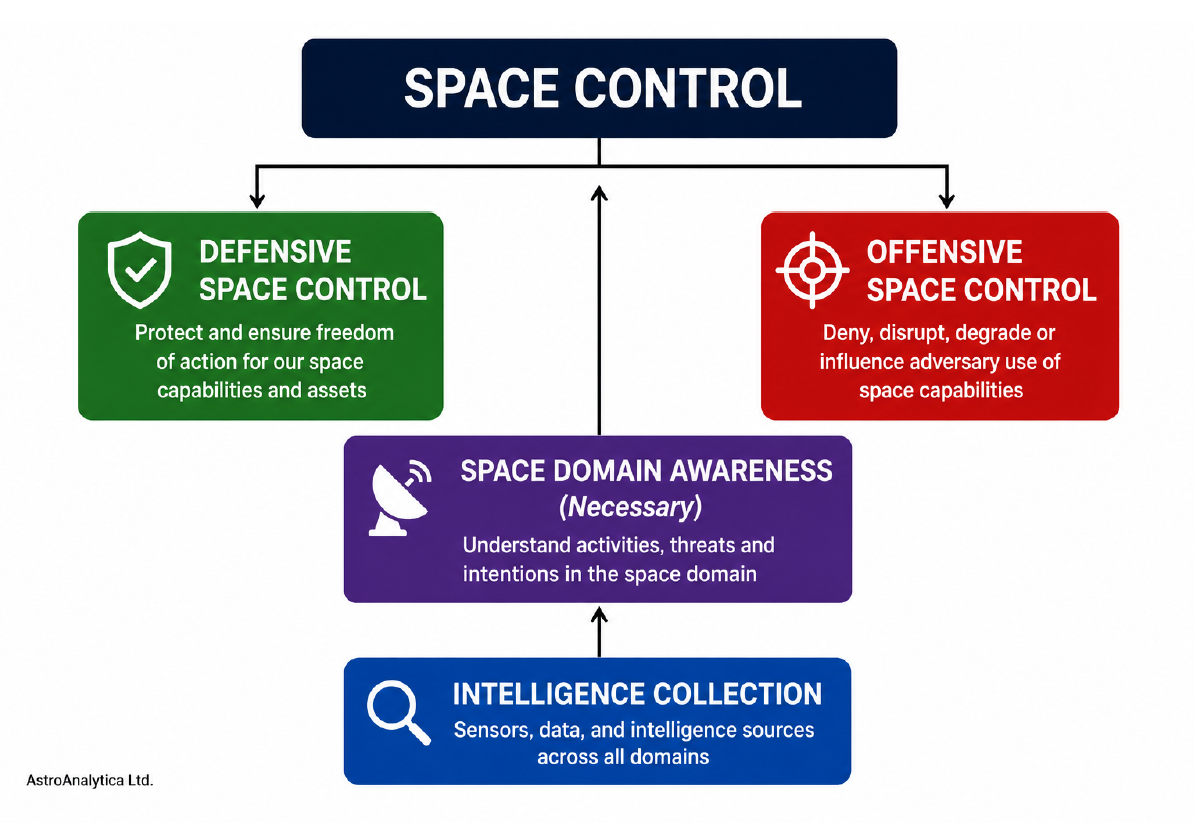
Both elements ultimately serve the same strategic purpose of preserving friendly freedom of action while constraining that of an adversary. Space control is therefore neither purely defensive nor inherently offensive. It is the operational framework through which military forces seek to assure continued access to the space domain in the face of competition and conflict. Recognising this distinction is essential if Britain is to move beyond awareness towards a genuinely credible military space posture.
VI. Strategic Optionality in Orbit
The Defence Investment Plan rightly recognises that many aspects of military space power are best pursued alongside trusted allies. The Deep Space Advanced Radar Capability, developed jointly with the United States and Australia, is an excellent example of this kind of cooperation. No country can independently build a truly global picture of the deep-space environment, and pooling resources, expertise, and infrastructure with close allies is both strategically sensible and fiscally responsible.
The more important question, however, is where cooperation ends and dependency begins. If Britain develops world-class SDA capabilities, yet remains reliant upon allies for many of the capabilities required to exercise space control, to what extent does it truly possess sovereign freedom of action in the space domain?
This is not an argument for strategic autonomy in the sense of isolation or self-sufficiency. Nor is it an argument against alliances. Rather, it is an argument for strategic optionality: the ability to operate seamlessly with allies while retaining sufficient sovereign capability to continue protecting British interests should allied priorities diverge or critical capabilities become unavailable.
Interoperability should therefore be understood as the product of sovereign strategic choice, not the consequence of sovereign capability deficits. The ultimate objective is not independence from allies but ensuring that cooperation remains a strategic preference rather than an operational necessity. In an increasingly contested space domain, that distinction may prove fundamental to Britain's future freedom of action.
VII. The Next Stage of British Space Power
The DIP marks an important milestone in Britain's evolution as a space power, but it should also be seen as the beginning rather than the culmination of that journey. The next Defence Space Strategy should build upon this foundation by articulating a coherent theory of space control that moves beyond recognition of the problem towards a clear operational doctrine. This should explain Britain's approach to defensive and offensive space control, establish capability priorities, clarify command relationships, define the respective roles of the RAF, UK Space Command, and allied organisations, and identify the minimum sovereign capabilities required to preserve freedom of action. It should also address escalation principles, legal and policy considerations, and the industrial base needed to sustain these ambitions over the long term. Ultimately, this is not simply a procurement challenge, nor merely an organisational one. It is, rather, a doctrinal challenge. Only by developing a coherent theory of space control can Britain fully realise the strategic vision set out in the DIP.
VIII. Conclusion
The Defence Investment Plan has crossed an important intellectual threshold by recognising that space is no longer a supporting domain but the central nervous system of modern, high-intensity warfare. While that recognition deserves to be welcomed, acknowledging the importance of space is only the beginning. The more difficult challenge lies in understanding that knowing what is happening in orbit is fundamentally different from controlling what happens there. Space domain awareness provides the information upon which military decisions are made, but it is space control that ultimately preserves freedom of action, protects critical capabilities, and shapes events in a contested environment.
The DIP has therefore taken the essential first step by recognising that future warfare depends upon control of the space domain. The next challenge, however, is to explain how Britain intends to exercise that control. Until then, SDA risks becoming mistaken for space control in the minds of British politicians, media, and the broader public.