
Orbital Data Centres: A Hard, Forward Look at Market and Geopolitical Realities
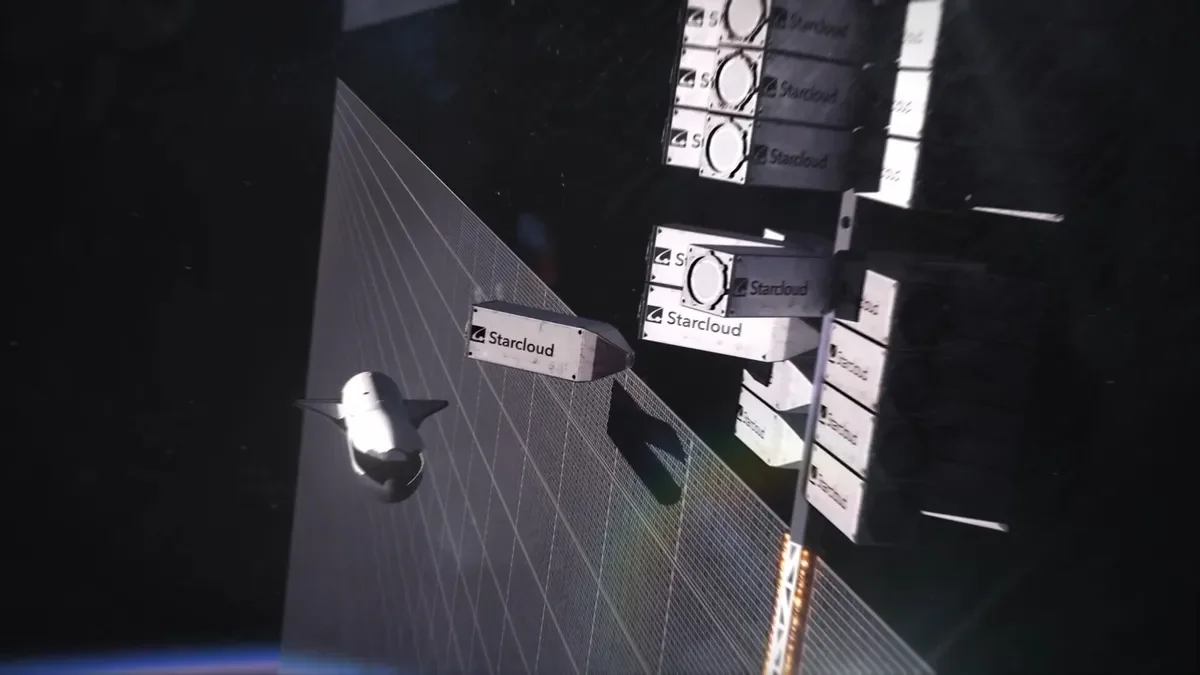
(Credit: Starcloud)
I. Introduction: The Seductive ODC Narrative
Over the past eighteen months, orbital data centres (ODCs) have evolved from an interesting engineering concept into one of the space sector's most compelling strategic narratives. Advocates argue that artificial intelligence's extraordinary appetite for electricity, cooling, land, and grid capacity makes the migration of computation into orbit not merely possible, but eventually inevitable. The narrative is both elegant and intuitively persuasive: AI demand is rising faster than terrestrial infrastructure can comfortably accommodate; data centres face mounting pressures from electricity costs, water consumption, planning restrictions, environmental regulation, and growing political opposition; while space appears to offer abundant solar energy, radiative cooling, and freedom from many of the physical and political constraints that increasingly shape infrastructure development on Earth.
That argument is not speculative or confined to niche corners of the space and AI sectors. It is being advanced by startups, analysts, researchers, and major companies such as SpaceX.
This AstroAnalytica analysis argues that the debate surrounding ODCs has been framed around the wrong question. Most discussion has focused on engineering feasibility, launch economics, and the environmental limitations of terrestrial data centres. Those are important issues, but they are not the decisive ones. The more fundamental question is whether ODCs are being compared with the right market in the first place. This is not primarily an engineering problem; it is a market-definition problem.
That distinction matters because the ODC industry risks making a familiar mistake, one that has recurred throughout the history of the commercial space sector. Again and again, emerging space industries have mistaken a large adjacent market for their own addressable market. The consequence is an investment narrative built around enormous Total Addressable Markets, ambitious infrastructure programmes, and optimistic growth projections, before sufficient attention has been given to identifying the specific customers, workloads, and commercial incentives that will sustain the underlying business. ODCs appear increasingly vulnerable to the same analytical trap.
This is not an argument against orbital data centres. On the contrary, we argue that their long-term prospects may be stronger than many current narratives suggest. But their greatest opportunities are unlikely to emerge from competing directly with terrestrial hyperscale cloud providers. Instead, they are more likely to arise as a new class of space-native computing infrastructure supporting applications and markets for which orbital execution provides a genuine economic, operational, or strategic advantage. That market is almost certainly smaller in the near term than many advocates imply, but it may also prove considerably more valuable, more defensible, and, ultimately, more investable.
II. The First Strategic Question
The way a market is defined determines the questions that investors, policymakers, and company executives ask about it. At present, the ODC debate is dominated by questions of engineering: Can ODCs be built? How much will they cost? When will they become economically viable? Can they compete with terrestrial hyperscale facilities? These are all legitimate questions, but they obscure a more fundamental one that has received remarkably little attention: what computing workloads are economically superior when performed by an orbital data centre?
The distinction is subtle but profound. Asking whether a workload can be performed in orbit is an engineering question. Asking whether it should be performed in space is a commercial and strategic one. Only when a workload is demonstrably superior in orbit, economically, operationally, or strategically, does it become part of the genuine addressable market for orbital computing.
This distinction has broader implications for the space sector. Commercial space stations have long been framed as serving tourism, manufacturing, research, media, and hospitality. In-space manufacturing has often been framed in terms of the global manufacturing economy. Reusable launch vehicles were initially discussed in the context of transforming access to all of space. In each case, engineering feasibility became intertwined with assumptions about the size of the eventual market. Yet history repeatedly demonstrates that infrastructure does not create demand simply because it exists. Rather, successful infrastructure emerges where clearly defined customer needs already exist or where entirely new capabilities create compelling reasons for customers to adopt them.
The central argument of this analysis is therefore straightforward. The orbital data centre industry should not be analysed as an extension of today's global cloud market, but as the emergence of a new category of space infrastructure. Once viewed through that lens, the questions become different, the market becomes narrower, and the investment case becomes considerably more rigorous. Yet paradoxically, it also becomes stronger.
III. The Great TAM Confusion
The enthusiasm surrounding ODCs often begins with an undeniably impressive statistic: the global cloud computing market is worth hundreds of billions of dollars and continues to grow rapidly as artificial intelligence accelerates demand for computational power. From there, it is tempting to conclude that orbital data centres are addressing this enormous market. However, this conflates an adjacent market with an addressable one. The global cloud market encompasses everything from email, video streaming, online retail, and enterprise software to scientific computing and AI. Most of these workloads have no compelling economic, operational or strategic reason to leave Earth, particularly as terrestrial hyperscale providers continue to improve energy efficiency, cooling technologies, and computing architectures.
The relevant market, therefore, narrows considerably at each stage of analysis. Within the broader cloud market lie compute-intensive workloads, some of which may benefit from being performed closer to where data is generated. This is where space begins to offer genuine advantages. Satellites already produce vast quantities of Earth observation, communications, and navigation data that can be processed in orbit rather than transmitted to the ground. From there, the market narrows further to orbital-native computing: applications such as autonomous constellation management, onboard AI, space domain awareness, missile warning, and eventually cislunar infrastructure, where performing computation in space creates capabilities that terrestrial infrastructure cannot easily replicate. Ultimately, the real addressable market for orbital data centres is not "cloud computing in space" but a much smaller set of specific orbital workloads for which space itself provides a measurable competitive advantage.
This distinction is more than semantic. It fundamentally changes how investors, policymakers, and industry should assess the sector. The critical question is not whether the global cloud market is enormous - it unquestionably is - but how much of that market survives successive tests of economic viability, operational necessity, and strategic value. Only those workloads that are demonstrably better performed in orbit, and for which customers are willing to pay a premium, constitute the real market for ODCs. That market may prove smaller than many advocates currently suggest, but it may also prove considerably more defensible and strategically valuable. In other words, ODCs almost certainly have a market, but it is a different market from the one many advocates describe.
One way to understand this categorical error is through the familiar investment concepts of Total Addressable Market (TAM), Serviceable Available Market (SAM), and Serviceable Obtainable Market (SOM). The TAM for orbital data centres is often presented as the entire global cloud or data centre industry - a market measured in hundreds of billions of dollars. Yet this says little about the market an ODC can realistically serve. The SAM is considerably smaller, comprising only those computing workloads that could conceivably migrate to orbit. Smaller still is the SOM: the subset of customers that not only could but are economically and operationally willing to purchase orbital computing services over terrestrial alternatives. Investors care far more about SAM and SOM than TAM because they determine whether revenues, margins, and returns are realistically achievable. A company may cite an enormous TAM, but unless it can demonstrate a credible path to capturing a meaningful SOM, the headline market size is of limited commercial value.
IV. The Environmental Narrative
A central pillar of the ODC narrative is that they shift computation away from the environmental constraints facing terrestrial infrastructure. The argument is straightforward and intuitively appealing. Terrestrial data centres face rising electricity prices, increasingly constrained grids, water scarcity for cooling, lengthy planning and permitting processes, carbon emissions, and growing political and social opposition to large-scale developments. ODCs, by contrast, are presented as being powered by abundant solar energy, cooled by the vacuum of space, unconstrained by terrestrial land use, and free from many of the environmental and regulatory pressures facing infrastructure on Earth. At first glance, this appears to represent a decisive competitive advantage.
The comparison, however, is incomplete because it implicitly assumes that environmental costs disappear once infrastructure moves into orbit. They do not: instead, they simply change form. ODCs still require energy-intensive manufacturing, repeated launches, complex thermal management systems, replacement hardware, autonomous servicing, end-of-life disposal, and responsible and continuous management for orbital congestion and debris. Indeed, maintaining computing infrastructure in space may require a continuous logistics chain of launches, servicing missions, and hardware replacement over operational lifetimes measured in years rather than decades. The relevant comparison is therefore not between infrastructure with environmental costs and infrastructure without them, but between two different environmental set of criteria.
Recognising this distinction does not necessarily weaken the case for ODCs; it arguably strengthens it by forcing a more honest assessment of where their comparative advantages genuinely lie. The question is not whether orbital infrastructure eliminates environmental externalities (it does not), but whether the environmental, economic, and strategic costs associated with operating in space are outweighed by benefits that cannot be realised on Earth. This shifts the debate away from simplistic claims of environmental superiority and towards a more rigorous comparison of competing infrastructure models. In doing so, it also reminds investors and policymakers that every infrastructure system carries environmental costs. The strategic question is not whether those costs exist, but where they arise, who bears them, and whether they create sufficient value to justify them.
V. The Innovation Fallacy: ODCs Are Competing Against Tomorrow
Perhaps the most important assumption underpinning many ODC business cases is one that is rarely stated explicitly: that tomorrow's orbital data centres will compete against today's terrestrial infrastructure. It is an understandable comparison because today's data centres face mounting pressures, including rising electricity demand, cooling requirements, grid constraints, planning delays, and growing environmental scrutiny. Yet markets are not static. Technologies evolve in competition with one another, and incumbent industries rarely remain unchanged in the face of new challengers.
The more appropriate comparison is therefore not between future ODCs and today's terrestrial facilities, but between future ODCs and future terrestrial innovation. The same environmental, economic, and political pressures cited in support of orbital computing are also powerful incentives for terrestrial operators to innovate. Data centre operators are already investing heavily in liquid and immersion cooling, direct-to-chip thermal management, waste heat recovery, artificial intelligence for workload optimisation, silicon photonics, more energy-efficient processors, advanced power electronics, geothermal energy, renewable integration, and, increasingly, small modular nuclear reactors. None of these developments eliminates the challenges facing terrestrial infrastructure, but collectively they may significantly reduce the very advantages that ODCs are expected to exploit.
This observation has important implications for market analysis. The competitive benchmark for ODCs is not a static snapshot of terrestrial computing taken in 2026. It is the trajectory of terrestrial computing over the next decade or more. If ground-based infrastructure becomes substantially more efficient, cheaper to operate, and less environmentally burdensome, then the economic case for migrating generic computing workloads into orbit becomes correspondingly more demanding. ODCs must therefore demonstrate not simply that they are superior to today's alternatives, but that they will remain superior after terrestrial competitors have responded to the same market pressures.
This suggests a broader strategic principle that extends well beyond the ODC industry. Every disruptive technology competes not against the present capabilities of incumbent industries, but against their future innovations. Investors, policymakers, and company executives who ignore this dynamic risk overstating both the pace and scale of technological disruption. For ODCs, the question is therefore not whether terrestrial infrastructure faces significant constraints (it unquestionably does), but whether those constraints will be alleviated more effectively on Earth or by moving computation into space. In short, every emerging technology competes against the future innovation of incumbents, not the present capabilities of incumbents.
VI. The Economics of Switching
Even if ODCs prove technically feasible and environmentally competitive, they face a more fundamental commercial question: why should a customer move a computing workload from Earth into orbit? This is subtly different from asking whether such a migration is technically possible. Throughout the history of technology, successful innovations have not simply demonstrated that they could replace incumbent systems; they have demonstrated compelling reasons why customers should incur the costs and risks of changing. The economics of switching are therefore as important as the engineering itself.
For most organisations, migrating critical computing workloads involves far more than comparing electricity prices or cooling costs. Customers must consider switching costs, system reliability, latency, cybersecurity, regulatory compliance, insurance, procurement processes, software compatibility, hardware upgrade cycles, operational resilience, and the total cost of ownership over many years. They must also weigh the opportunity cost of adopting an emerging technology rather than continuing to invest in increasingly capable terrestrial infrastructure. Unless orbital computing offers a clear and measurable advantage across one or more of these dimensions, inertia alone will favour existing solutions.
This helps explain why the realistic addressable market for ODCs is likely to be narrower than headline projections suggest. Many workloads may be technically capable of operating in space, but relatively few, if any, will justify the commercial, operational, and organisational costs of migration. The most promising opportunities are therefore unlikely to be those where orbital infrastructure merely replicates terrestrial capabilities, but those where space itself creates unique value that cannot be economically or operationally reproduced on Earth. In competitive markets, superiority is not measured by what a technology can do, but by what customers are willing to change for.
VII. The Real Market Emerges
None of this suggests that ODCs lack a viable future. Rather, it suggests that the industry may be searching for its first market in the wrong place. Instead of viewing ODCs primarily as competitors to terrestrial hyperscale facilities, it may be more useful to view them as foundational infrastructure for the emerging space economy. History suggests that transformative infrastructure industries rarely succeed by attempting to replace mature incumbents overnight. They succeed by solving a specific problem exceptionally well before expanding into adjacent markets. For ODCs, that first problem may not be cloud computing on Earth, but computation in space.
The most immediate opportunities lie in supporting space infrastructure itself. Modern satellite constellations generate vast quantities of data that must be processed, prioritised, and acted upon with increasing speed and autonomy. Earth observation imagery, satellite health monitoring, autonomous constellation management, space domain awareness, in-orbit servicing, rendezvous, and proximity operations, and future missile warning architectures all benefit from moving computation closer to where data is generated. In these cases, orbital computing is not simply an alternative to terrestrial processing; it becomes an operational enabler that reduces latency, conserves communications bandwidth, and increases resilience.
Beyond commercial satellite operations lies a second market driven by governments and national security. Defence ministries, intelligence agencies, and civil resilience organisations are placing growing emphasis on sovereign digital infrastructure, resilient space architectures, and the ability to operate in contested environments. Classified processing, autonomous military space systems, distributed command-and-control architectures, and resilient national infrastructure may all represent applications where strategic value outweighs purely commercial considerations. Here, ODCs should perhaps be understood less as cloud infrastructure and more as sovereign strategic capability.
A third market emerges as humanity extends its presence beyond low-Earth orbit. Sustained operations around the Moon, deep-space exploration, robotic missions, scientific research, in-space manufacturing, and, eventually, permanent cislunar infrastructure will all require increasing computational capability far from terrestrial data centres. As communications delays increase with distance from Earth, greater autonomy becomes essential. Processing data where they are generated will not simply improve efficiency; it will become a prerequisite for safe and effective operations. In this context, ODCs become part of the enabling infrastructure of an expanding space economy rather than an extension of terrestrial cloud computing.
Only after these markets begin to mature does a broader commercial opportunity become conceivable. Over time, improvements in launch economics, orbital servicing, autonomous operations, and space-based energy systems may enable selected terrestrial workloads to migrate into orbit where doing so offers a demonstrable economic or operational advantage. Even then, the migration is likely to occur selectively rather than universally. General-purpose cloud substitution should therefore be understood not as the industry's starting point, but as a possible long-term outcome of decades of technological and market evolution.
Viewed through this lens, the opportunity facing ODCs becomes both narrower and more compelling. Their future may not lie in becoming another hyperscale cloud provider, but in becoming the computational backbone of the space economy itself. That market is undoubtedly smaller today than the global cloud industry, yet it is also characterised by fewer established competitors, stronger strategic demand, and applications for which orbital computing is not merely possible, but genuinely indispensable. In strategic terms, that may prove to be the more valuable market to pursue.
VIII. Geopolitics Changes the Market
The commercial case for ODCs is only part of the story. As computing, artificial intelligence, and space infrastructure become increasingly central to economic and national power, orbital computing should also be considered through a geopolitical lens. This changes the market in important ways because governments do not invest in strategic infrastructure according to the same criteria as commercial cloud providers. National resilience, technological sovereignty, military capability, and strategic autonomy frequently justify investments that would not satisfy purely commercial return-on-investment calculations. Consequently, the addressable market for ODCs cannot be understood solely in terms of cloud computing demand; it must also be assessed in terms of national security, critical infrastructure, and geopolitical competition.
This broader perspective suggests that ODCs may ultimately derive greater value from enabling sovereign capabilities than from replacing terrestrial hyperscale facilities. Governments have already demonstrated a willingness to invest in sovereign launch capability, sovereign satellite communications, sovereign positioning, navigation, and timing (PNT) systems, and sovereign Earth observation constellations. It is not difficult, therefore, to envisage a future in which sovereign orbital computing becomes part of the same strategic architecture. Resilient space-based computational infrastructure could support autonomous satellite constellations, missile warning systems, intelligence processing, command-and-control networks, and other mission-critical applications where survivability and assured access are valued at least as highly as cost efficiency.
Viewing ODCs through this lens also introduces a series of geopolitical questions that are often not considered in the debate. Who owns and controls the infrastructure? Which countries manufacture the processors and communications systems? Which launch providers deploy and service the platforms? What export controls, investment screening mechanisms, or sanctions regimes apply? How are such facilities protected in times of geopolitical tension or armed conflict? These are not minor considerations. They are likely to become important in determining where ODCs are built, who is allowed to use them, and how international partnerships are structured. As with satellite communications, navigation systems, and undersea cables, infrastructure that appears primarily commercial can quickly acquire strategic significance.
This perspective also suggests that the industry's current emphasis on environmental sustainability, while entirely legitimate, may not prove to be the principal driver of long-term adoption. History demonstrates that transformative infrastructure often succeeds because it delivers strategic advantage as much as a commercial return. Railways, the telegraph, undersea cables, aviation, satellites, and cloud computing all evolved from commercial innovations into infrastructure of great national importance. ODCs may follow a similar trajectory. Their enduring value may therefore lie not simply in reducing pressure on terrestrial infrastructure, but in becoming an essential component of the digital architecture that underpins future space power, national resilience, and an increasingly space-enabled global economy.
IX. Lessons from Space History
The evolution of the commercial space station market offers a useful historical and contemporary parallel for ODCs. During the past two decades, concepts for privately operated space stations have been accompanied by slick renderings of orbital hotels, pharmaceutical manufacturing, media production, industrial research, tourism, and a host of other commercial activities. Many of these applications remain technically plausible and may yet emerge over time. What is proving more difficult than the engineering, however, is identifying sufficient near-term demand to sustain the underlying infrastructure. In practice, commercial space station developers continue to rely heavily on government agencies as anchor customers while broader commercial markets mature.
The lesson for ODCs is not that history will necessarily repeat itself, but that infrastructure and markets rarely develop at the same pace. There is a natural tendency within emerging industries to assume that if enabling infrastructure can be built, demand will inevitably follow. Experience suggests otherwise, as infrastructure succeeds when it solves clearly defined problems for identifiable customers who are prepared to pay for the capability it provides. Markets, therefore, are discovered and cultivated over time; they are seldom created simply by announcing ambitious infrastructure projects.
ODCs may ultimately follow a similar trajectory. Their long-term potential could indeed extend to supporting a much broader range of commercial computing services than is currently feasible. Yet their early success is more likely to depend upon a relatively small number of high-value applications and anchor customers than upon immediate substitution for terrestrial cloud computing. The strategic challenge, therefore, is not merely to build orbital computing infrastructure, but to identify the first markets whose demand is sufficiently compelling to justify it. As commercial space stations illustrate, infrastructure follows demand far more often than demand follows infrastructure.
X. Strategic Implications
The implications of this analysis extend well beyond market identification and sizing. The question facing ODC developers, investors, and policymakers is no longer simply whether orbital computing has a future, but what kind of future it is likely to have. Throughout this analysis, we have argued that the industry's principal challenge is not technological feasibility but market definition. Once ODCs are understood as strategic space infrastructure rather than direct substitutes for terrestrial hyperscale facilities, the commercial, investment, and policy implications change significantly.
orbital compute providers
For ODC companies, the opportunity may therefore lie in reframing their value proposition. Rather than presenting orbital computing primarily as an environmentally preferable alternative to terrestrial cloud infrastructure, companies should consider positioning themselves as providers of the computational backbone of the emerging space economy. This narrative aligns more naturally with identifiable markets in satellite operations, autonomous space systems, sovereign digital infrastructure, Earth observation, defence, cislunar logistics, and future in-space industry. It also shifts the discussion away from competing directly with highly efficient terrestrial hyperscale providers and towards creating capabilities that terrestrial infrastructure cannot easily deliver.
investors
For investors, this analysis suggests a corresponding shift in due diligence. The critical questions are not how large the theoretical cloud market may become, but which workloads are genuinely space-native, who the likely anchor customers are, and whether those customers derive sufficient operational or strategic value to justify sustained demand. This requires moving beyond Total Addressable Market projections towards a much more disciplined assessment of Serviceable Available and Serviceable Obtainable Markets. More importantly, investors should recognise that not all returns will be driven by commercial cloud adoption. As history repeatedly demonstrates, strategically important infrastructure often commands a premium because governments value resilience, sovereignty, and assured access alongside commercial performance. Companies capable of serving both commercial and strategic markets may therefore possess more durable business models than those relying solely upon hyperscale cloud substitution.
policymakers
For policymakers, the implications may be more profound still. ODCs should not be viewed simply as another component of digital infrastructure or as an environmental response to terrestrial data centre constraints. Rather, they have the potential to become an enabling technology for future space power, supporting sovereign computational capability, resilient command-and-control architectures, autonomous space operations, and national digital resilience. In that context, policy discussions shift away from questions of sustainability alone towards broader considerations of industrial strategy, technological competitiveness, trusted supply chains, and national security. The strategic value of orbital computing may ultimately prove considerably greater than its environmental benefits alone would suggest.
XI. Conclusion
The orbital data centre debate has largely been framed as a contest between terrestrial and orbital computing. This analysis argues that such a comparison, while understandable, obscures the more important strategic question. The issue is not whether computation can be moved into orbit, nor whether orbital data centres can eventually compete with terrestrial hyperscale facilities. It is whether orbital computing creates capabilities, markets, and strategic advantages that cannot be realised as effectively from the ground.
History suggests that transformative infrastructure industries rarely begins by the wholesale replacement of mature incumbents. Railways did not eliminate roads; commercial aviation did not displace maritime transport; and cloud computing did not immediately replace enterprise servers. Instead, each established itself by solving a narrowly defined problem exceptionally well, building a sustainable customer base, and expanding as technology, economics, and demand evolved. There is every reason to believe that orbital data centres will follow a similar trajectory. Their earliest successes are likely to emerge not through the wholesale substitution of terrestrial cloud computing but by enabling applications in which orbital data centres are demonstrably superior.
In this light, the future of orbital data centres appears both more modest and more significant than current narratives suggest. The near-term commercial market may indeed prove considerably smaller than many headline projections imply. Yet that smaller market may also offer stronger competitive advantages, higher barriers to entry, greater strategic relevance, and more durable customer demand. Far from weakening the investment case, a more rigorous definition of the addressable market may strengthen the case for orbital data centres by aligning technological ambition with commercial reality.
Ultimately, the orbital data centre industry may be remembered not because it solved the environmental challenges of terrestrial computing, but because it formed the digital infrastructure backbone that enabled humanity's expanding presence in space. The question, therefore, is not whether orbital data centres will become 'the cloud in space'. It is whether they will become the computational foundation upon which the future space economy, and perhaps future space power, is built.