
(credit: ESA)
Earlier this summer, investor and space industry analyst Filip Kocian posed an interesting question on X: what might a space strategy for Schwarz Group – the German owner of Lidl and Kaufland – look like?
At first glance Kocian’s question might seem odd. Schwarz is one of Europe’s largest retailers, not a technology or aerospace company. Yet Kocian does point to a remarkable trend. The requirements of operating thousands of supermarkets, hundreds of warehouses, and logistics hubs have led the group to develop its own digital infrastructure to manage and operate it all. What began as an internal operational capability has evolved into Schwarz Digits, a company that spans cloud computing, cybersecurity, and artificial intelligence, and has more recently expanded into telecommunications.
Instead, Kocian’s thought experiment was whether space might represent another adjacency for Schwarz Group. The more interesting question, perhaps, is not whether Lidl might one day own and operate its own satellites; rather, it is what Schwarz tells us about the changing relationship between space and the wider economy.
This matters particularly in Europe today. The 2026 GALAXY Report by ASD Eurospace, based on interviews with 15 CEO’s across Europe’s space industry, diagnoses a sector with strong technical capabilities but weak scale, fragmented demand, poor industrial performance, and growing concerns about strategic autonomy. The report also hints at something larger: space demand is increasingly connected to digital infrastructure, while space itself is becoming part of a wider technological ecosystem, and it is here that Kocian’s question about Schwarz Group becomes more than a curiosity.
Follow the Requirement, Not the Sector
Schwarz’s technological evolution can be read as a series of capability adjacencies that form a technological stack. It looks something like this:
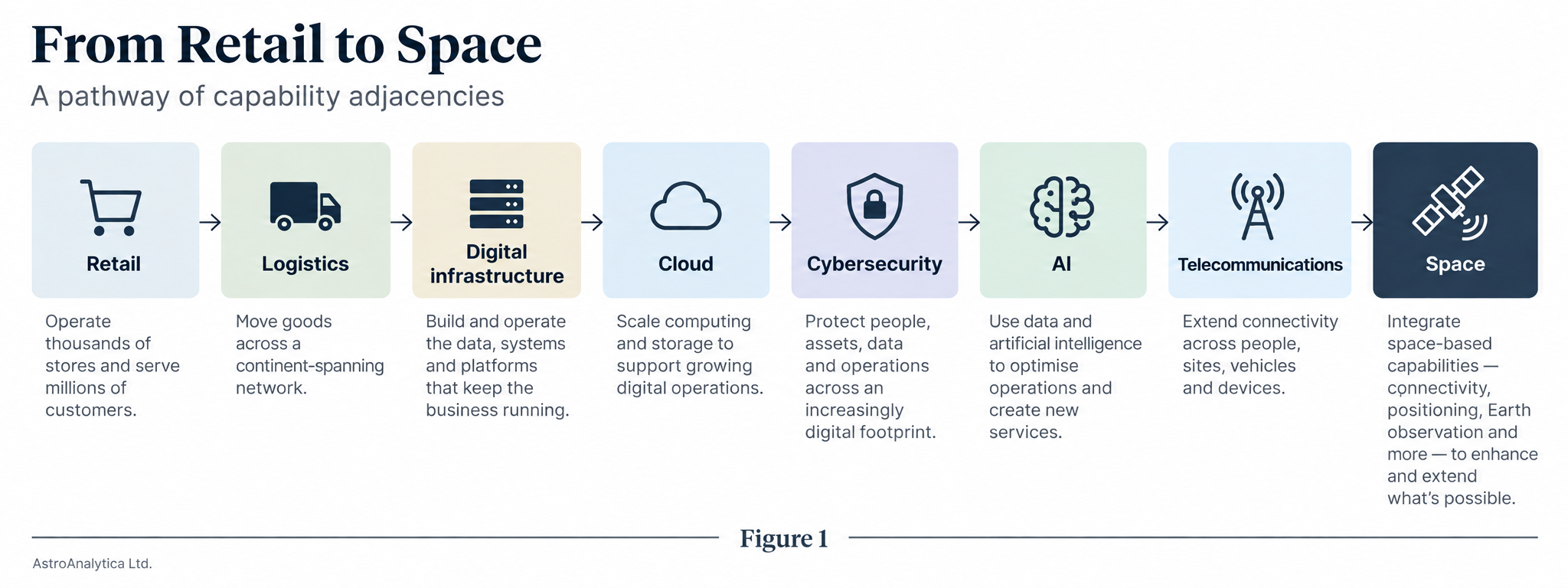
A supermarket retailer operating a continent-spanning logistics network depends upon communications, positioning, navigation, and timing (PNT), supply-chain visibility, computing, and increasingly autonomous systems. Satellite Internet-of-Things (IoT), Earth observation, resilient PNT, and satellite communications could all intersect with those requirements.
None of this, of course, means that Schwarz Group needs a satellite constellation. A corporate space strategy can operate at several levels:
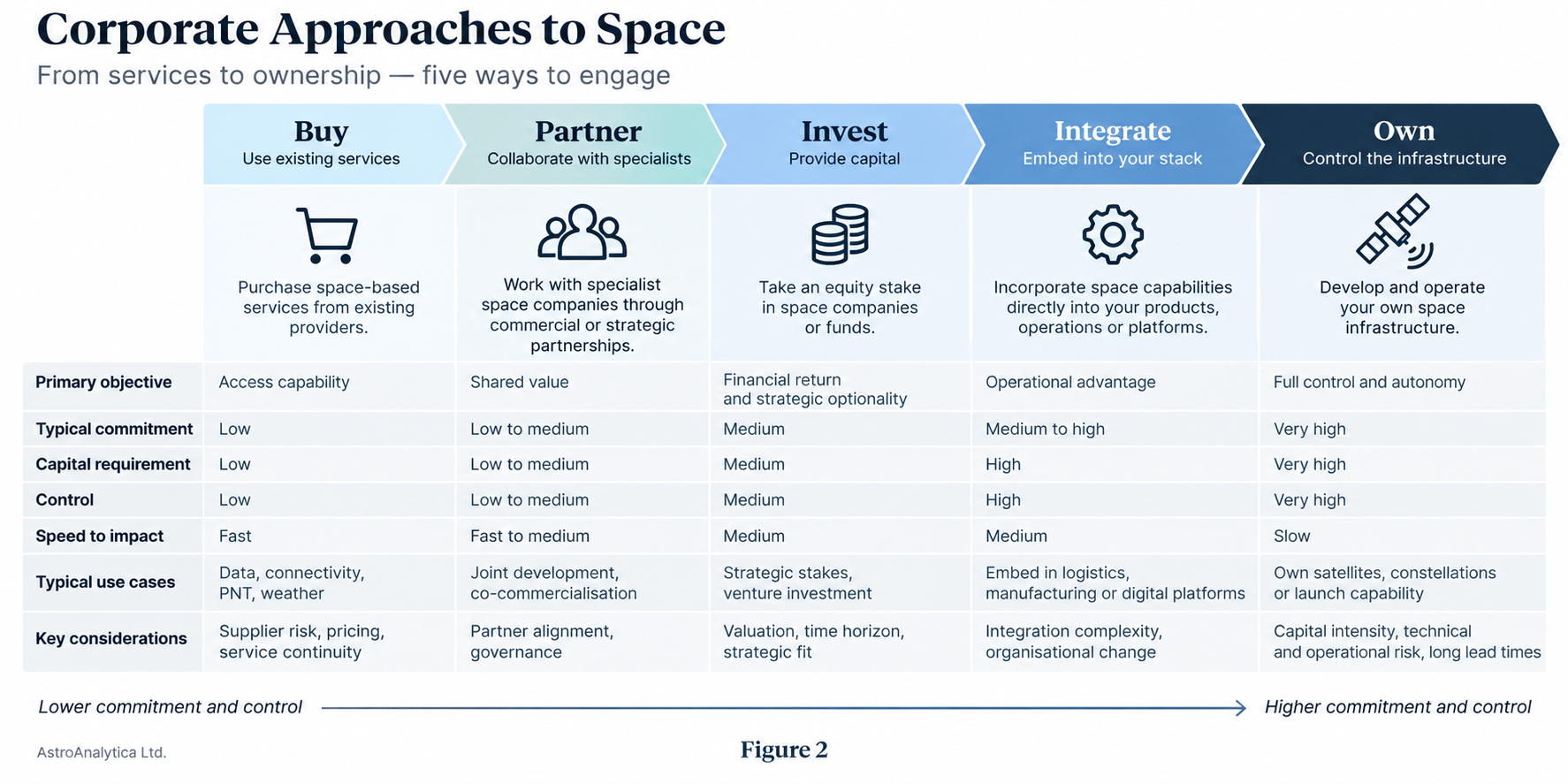
The relevant question, therefore, is not whether a particular company enters the space industry; it is whether space provides a superior way of accomplishing something the company already needs to do?
One of the most revealing observations in the Eurospace GALAXY Report comes from an interviewed CEO who complains that European space discussions too often begin with technologies rather than need: “We build launch vehicles, but for whom? Why?” The timing of that observation is striking as, on 5 September 2026, Germany’s Isar Aerospace successfully reached orbit with its Spectrum launch vehicle from the Andøya Spaceport in Norway, marking the first commercial orbital launch from continental Europe. It was a historic demonstration of European technological capability.
But technological success does not itself answer the CEO’s question. Spectrum now works, but the harder question is what combination of commercial, defence, and sovereign demand will sustain it at a commercially meaningful cadence and scale. Europe’s challenge is therefore not simply to build more space capability, but to work backwards from what European governments, companies, and citizens actually need space to do.
Look Outside the Space Industry
The Eurospace GALAXY Report approaches Europe’s predicament primarily from inside the sector. Its proposed remedies follow naturally, ranging from aggregating institutional demand, providing long-term visibility, enforcing European preference, creating long-lived infrastructures, and reforms in procurement. These measures may well be necessary, but the report also acknowledges that Europe lacks a strong commercial demand base in newer fields such as connectivity and data services, while identifying an opportunity to position space within a wider digital and industrial ecosystem.
That observation, however, needs to be taken further. Europe’s challenge may not simply be how to create demand for the space industry; it may be how to connect European space capabilities to the strategic requirements of Europe’s much larger terrestrial industrial base. That approach reverses the usual direction of analysis, where existing space capability is perpetually in search of viable applications. Instead, the approach should be to take existing requirements from governments and companies, identify capability gaps where space solutions are a good fit, and, in turn, create genuine demand and conditions for sustained investment.
The same phenomenon is already visible in the defence sector. Modern military architectures increasingly combine sensing, connectivity, computing, AI, command and control, and effectors, as follows:
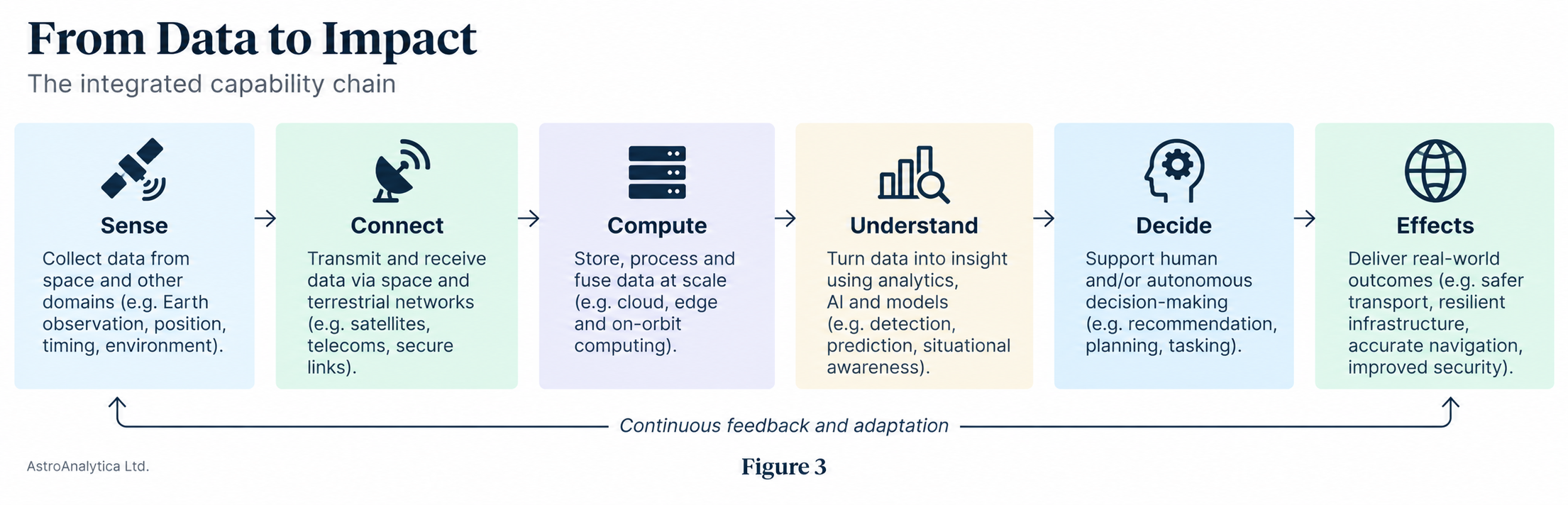
The commercial equivalent might look like the following:
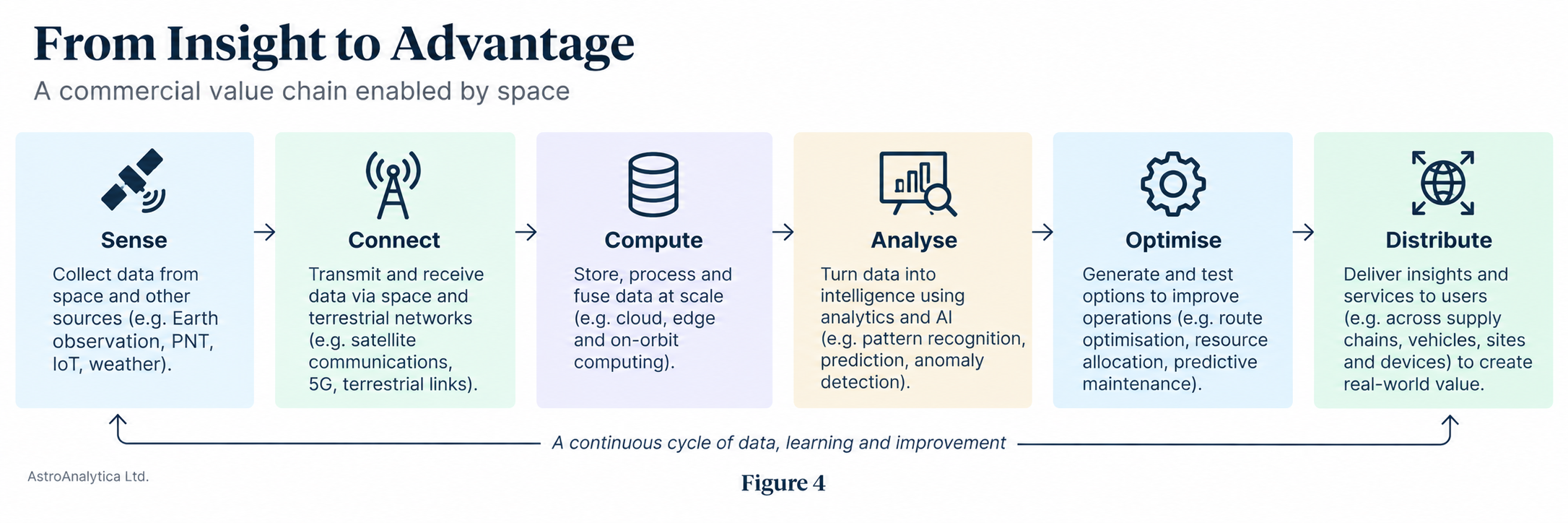
The purposes and end-goals obviously radically differ, but the technological convergence does not. Space is increasingly becoming a layer inside larger systems rather than a self-contained industrial category.
Space Adjacency Creates Geopolitical Adjacency
As space capabilities migrate into ordinary corporate infrastructure, their vulnerabilities naturally migrate with them. For example, imagine a European commercial logistics network dependent upon satellite communications, IoT, PNT, Earth Observation data, and cloud computing that integrates them. A company board may regard this as digital transformation, but strategically it has acquired geopolitical dependencies. A board might then face nontrivial questions such as who owns the satellites? Which national jurisdiction controls them? Could a government restrict services? Could sanctions or export controls remove a supplier or operator? How resilient is the system to jamming, spoofing, or cyber attacks?
Developments surrounding the proposed EU Space Act make these questions considerably less hypothetical than many executives might expect. The proposed Act would establish common European requirements concerning safety, resilience, and sustainability. Importantly, those requirements would apply not only to European operators but also to non-European companies providing space services in the EU market. The European Commission presents this as creating a predictable regulatory environment and a level playing field.
The United States, however, sees at least parts of the EU’s emerging approach differently. Ahead of an international space summit convened by President Emmanuel Macron in Paris on 9-10 September 2026, the White House’s Office of Science and Technology Policy (OSTP) has pressured U.S. space companies to stay away, telling them that participation would imply support for EU policy positions opposed by Washington, DC. SpaceX. Blue Origin, and other American companies have subsequently withdrawn, although the Trump administration has not formally prohibited attendance.
The significance of this goes beyond a diplomatic spat. It demonstrates that questions concerning who provides space infrastructure, who regulates it, and under what conditions companies receive market access are becoming questions of geoeconomic power.
The Eurospace GALAXY Report calls for European preference in strategic capabilities. The U.S. reaction offers a glimpse of what pursuing greater European control can entail. Strategic autonomy in space is not cost-free, as industrial policy and regulation can generate pressure from allies whose companies benefit from existing market structures. Nor is U.S. concern inherently irrational, as rules applying to foreign providers operating inside a market of hundreds of millions of people inevitably have competitive consequences, even when designed for legitimate safety, resiliency, or sustainability purposes.
The deeper point here is not that Washington is bullying Europe, or that Brussels is engaging in disguised protectionism, it is that once space becomes critical economic infrastructure, the regulation of space becomes geoeconomic policy.
From Dependency to Agency
All of this requires a more discriminating concept of sovereignty. Critical dependencies need to be made resilient against residual vulnerabilities and known threats, therefore creating the need for sovereignty. Yet sovereignty need not mean ownership since it can also be exercised through procurement, regulation, standards, market access, alliances, and assured access, as well as through indigenous capabilities.
Isar Aerospace illustrates one end of this sovereignty spectrum. If dependence upon external launch providers creates unacceptable vulnerability, indigenous launch capability acquires strategic value beyond the commercial revenue generated by individual launches.
The proposed EU Space Act illustrates another example. Europe may exercise agency over infrastructure it does not own by determining the conditions under which providers can operate within its market.
The objective, therefore, should not be autonomy for its own sake, but that sufficient agency over strategically consequential dependencies, such as the ability to choose providers, establish rules, substitute capabilities, withstand disruption, and prevent another actor from exercising unacceptable leverage, be established.
As a result, Europe needs not just a map of it space industry supply chain but also a map of the terrestrial, non-space supply chains whose functioning increasingly depends upon space, and a concept of who ultimately controls those dependencies.
Beyond the Space Economy
The Eurospace GALAXY Report calls for Europe to move “from fragmentation to scale” and “from programmes to power.” That may require another conceptual transition from thinking primarily about the European space industry to thinking about Europe as a space-dependent economy.
Imagine if Schwarz Group did operate an infrastructure and technology stack that combines cloud computing, AI. Terrestrial telecommunications, satellite connectivity, PNT, and satellite imagery. What percentage of that stack comprises and belongs to the “space economy?” There may not, in fact, be a useful answer. This does not mean that specialist space companies disappear; instead, it may mean that space becomes sufficiently important that its economic boundaries begin to dissolve, and herein lies a paradox: the less meaningful the “space economy” becomes as a distinct economic category, the more consequential space becomes as an arena of geopolitical and geoeconomic competition.
Filip Kocian’s Schwarz Group thought experiment, the Eurospace GALAXY Report, Isar Aerospace’s successful launch, and the transatlantic dispute over EU space regulation are all different manifestations of the same underlying transformation.
The next great expansion of European space demand may be easiest to see by looking outside the space industry, and space geopolitical risk will inevitably follow.