
Russia, ICEYE, and Orbital Competition: Emerging Realities for Europe
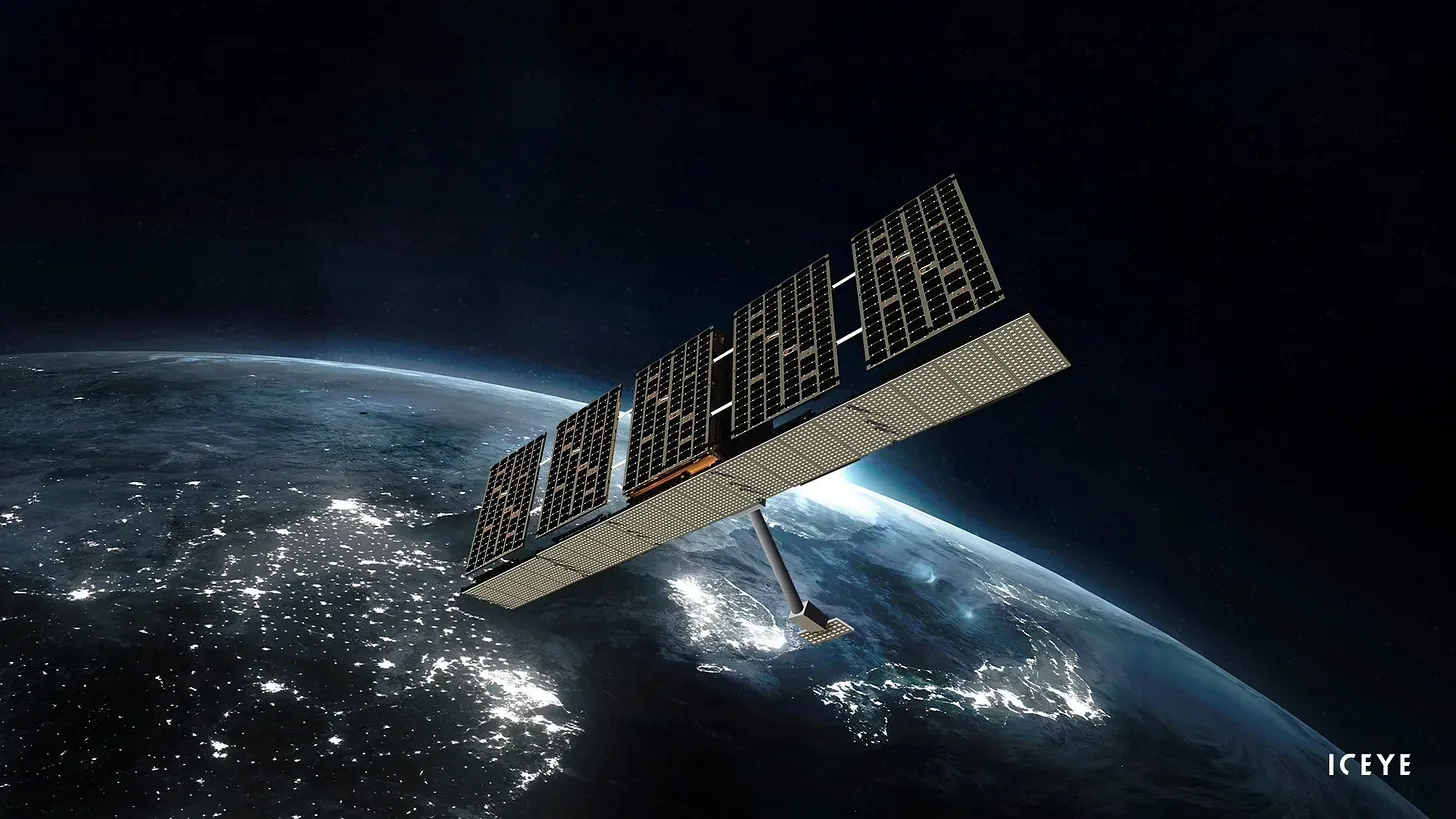
Image courtesy of ICEYE
Introduction
Recent reports that multiple Russian satellites have manoeuvred near a commercial ICEYE synthetic aperture radar (SAR) satellite should not be dismissed as an isolated incident. Nor should the incident immediately be interpreted as evidence that Russia has developed a practical wartime doctrine for physically hunting commercial constellations satellite-by-satellite in orbit. The deeper significance lies elsewhere.
The incident appears to point toward an emerging Russian approach to orbital competition that blends signalling, operational experimentation, coercive ambiguity, and political intimidation into something more coherent than many Western analysts probably feel comfortable admitting. Moscow is, likely, not rehearsing a literal one-for-one wartime campaign of physically hunting down commercial satellites across proliferated constellations. That would make little operational sense. What may be emerging instead is a broader method of space-enabled geopolitical confrontation in which orbital pressure, ambiguity, intimidation, and persistent probing become normal features of strategic competition.
Background and Context
Context matters greatly here.
ICEYE is not simply another commercial Earth observation company. It is a Finnish company operating within a profoundly altered European strategic environment. Finland’s accession to NATO fundamentally transforms the northern European security landscape and remains deeply resented in Moscow. At the same time, ICEYE has become closely associated with Western and Ukrainian ISR support during the war in Ukraine, where commercial SAR imagery increasingly forms part of wider coalition warfighting architectures. ICEYE now provides data directly to NATO headquarters and continues rapidly expanding its sovereign defence partnerships across Europe, including providing satellites to the Dutch, Swedish, and Portuguese militaries.
More recently still, Poland, one of NATO’s frontline states facing Russia, has integrated ICEYE into the backbone of its emerging space-based ISR capability. In May 2026, ICEYE formally handed over four SAR satellites to the Polish Armed Forces under the POLSARIS/MikroSAR programme.
From a Russian strategic perspective, this likely changes the threat profile of ICEYE entirely.
The company increasingly occupies an ambiguous but strategically important position somewhere between commercial infrastructure, allied military support capability, and coalition ISR architecture. Under such conditions, Russian proximity operations may represent not simply technical experimentation, but deliberate signaling directed simultaneously at Finland, Poland, NATO, European commercial space actors, insurers, investors, and politically hesitant Western governments.
Russian Activity Around ICEYE-X36
At first glance, reports that four or even five Russian satellites may be manoeuvring around a single ICEYE satellite (ICEYE-X36) appear operationally inefficient and strategically unsustainable. Modern proliferated commercial constellations are specifically designed to complicate such approaches. ICEYE itself has launched roughly 70 satellites since 2018 and is scaling toward production rates approaching one satellite per week.

Attempting physically to neutralise every relevant commercial spacecraft in wartime would prove prohibitively expensive, operationally exhausting, and strategically impractical, which leads to the likelihood that the threat of physical destruction may not be the point.
Instead, the Russian activity likely serves several overlapping purposes simultaneously:
operational rehearsal for future co-orbital counterspace missions,
testing command-and-control and proximity operation techniques,
intelligence collection of ICEYE’s SAR characteristics,
strategic signalling toward NATO,
intimidation of commercial operators,
and normalisation of persistent orbital coercion.
Importantly, this behaviour also differs in important respects from earlier Russian co-orbital activities. Since at least 2010, Russia has conducted extensive rendezvous and proximity operations (RPO) testing in both LEO and GEO involving systems associated with the Nivelir and potentially Burevestnik programmes. Earlier incidents typically involve one or two “inspector” satellites manoeuvring near U.S. government spacecraft or releasing sub-satellites or projectiles. The Kosmos-2542/2543 incident in 2020, for example, involved close manoeuvres near an American reconnaissance satellite and the later release of a projectile-like object that U.S. officials characterised as a non-destructive antisatellite (ASAT) test.
The ICEYE incident appears to be somewhat different. The apparent use of four or five satellites suggests something potentially more sophisticated than simple stalking behaviour. One possibility is that Russia may be experimenting with forms of co-orbital interference or electronic disruption against SAR systems rather than preparing for a purely kinetic attack. If correct, this interpretation makes considerable strategic sense.
Synthetic aperture radar systems are fundamentally electromagnetic systems whose military value depends upon transmitting, receiving, and processing radar emissions. Multiple satellites manoeuvring in coordinated proximity could potentially support:
signal characterisation,
emissions intelligence,
geometry testing,
distributed sensing,
electronic support measures,
or experimentation with localised interference techniques.
The Russian satellites may not all be “attackers” in the kinetic, conventional sense. Some may instead support collection, calibration, relay, or command-and-control experimentation as part of wider distributed orbital electronic warfare concepts. This would align closely with broader Russian military preferences for ambiguity, a heavy reliance on electronic warfare, tendencies to engage in asymmetric competition coupled with coercive signalling, and escalation management below the threshold of overt conflict.
It would also help explain why Russia chose a politically sensitive but non-American commercial target such as ICEYE. ICEYE SAR satellites are strategically relevant and operationally useful to Ukraine and NATO, but sit within a more ambiguous escalation environment than a direct challenge to a U.S. government SAR satellite.
The Increasingly Irrelevant Commercial-Military Distinction
Most importantly, the incident underscores how rapidly the distinction between civilian and military space infrastructure is eroding. From a Russian strategic perspective, companies such as ICEYE no longer exist purely as neutral commercial actors. Commercial ISR systems directly supporting Ukrainian military operations increasingly have become part of the wider battlespace, whether European governments feel politically comfortable admitting this reality or not.
This represents an important strategic development, as for decades, much European and Western space discourse has implicitly assumed that commercial systems occupy an ambiguous middle ground since they are privately owned, globally interconnected, legally civilian, but strategically useful. The war in Ukraine has shattered that ambiguity. Commercial satellite communications, Earth observation (SAR and optical), cloud infrastructure, and data analytics now form part of operational warfighting ecosystems in Ukraine and other conflicts around the world. Russia, China, and likely others increasingly appear willing to treat such systems accordingly.
Europe’s Spacepower Vulnerabilities
This has profound implications for European and allied spacepower. The true vulnerability may not ultimately lie in orbit itself, but in the political and institutional ambiguity surrounding Western coalition space operations. Russia likely recognises that European military space remains underdeveloped not simply technologically, but conceptually and organisationally. It is unclear, for example, who exactly owns the mission sets for space control, counterspace operations, space system protection, resilience, reconstitution, and broader national and coalition space defence. National militaries? National space commands? NATO or the European Space Agency? Commercial operators such as Starlink and ICEYE? Some combination of all of the above?
Even where technical capabilities exist, the political and doctrinal coherence surrounding their employment often remains uncertain, and this ambiguity itself may represent a strategic vulnerability. Most likely, Russia increasingly calculates that Western and European coalition spacepower can be disrupted not simply through technical attacks, but through political hesitation, legal uncertainty, alliance fragmentation, and escalation fears. Highly capable commercial and military orbital architectures may prove strategically brittle if governments remain unwilling psychologically or politically to accept the realities of modern space-enabled warfare.
Implications for Insurers and Satellite Financing
Additionally, one underexplored dimension of the ICEYE incident is its likely impact upon insurers and the wider financial ecosystem underpinning commercial space activity. Even if Russian proximity operations are not explicitly designed to target insurers psychologically, the implications for underwriting, risk modelling, liability assessment, and investor confidence are potentially profound.
Historically, much of the commercial space sector evolves under assumptions inherited from the post-Cold War era where states and companies enjoyed relatively permissive orbital access, manageable geopolitical risk, low probability of deliberate state-on-state interference, and the belief that commercial systems occupied a politically ambiguous space between civilian infrastructure and military utility. That environment is increasingly eroding.
The ICEYE case illustrates how rapidly commercial operators can become entangled in geopolitical confrontation once their systems contribute materially to military operations, intelligence support, or alliance warfighting architectures. From an insurer’s perspective, this fundamentally alters the risk profile of certain categories of commercial space infrastructure, and the issue is not simply the possibility of physical destruction. Persistent orbital coercion, proximity operations, cyber interference, electronic disruption, and geopolitical intimidation may prove more destabilising from an insurance perspective precisely because they occupy ambiguous territory between peacetime competition and overt warfare.
This creates several problems simultaneously. Attribution becomes difficult, ambiguity complicates liability assessment, and investors may begin reassessing the geopolitical exposure of commercial operators closely integrated into NATO or Ukrainian military ecosystems. Insurers may demand higher premiums or tighter exclusions for dual-use systems increasingly exposed to gray-zone counterspace activity. In effect, geopolitical competition in space may increasingly migrate into the financial architecture sustaining commercial spacepower itself.
This matters because modern European spacepower now depends heavily upon commercial ecosystems. If adversaries can generate strategic pressure indirectly through insurers, investors, legal ambiguity, or market uncertainty, then commercial resilience becomes inseparable from national strategic resilience – and this is the real strategic warning embedded within the ICEYE incident.
A Wake-Up Call for Europe
Europe increasingly depends upon commercial space infrastructure for military effectiveness, economic resilience, intelligence collection, and alliance operations. Yet Europe still behaves in many respects as though space-enabled warfare remains hypothetical, peripheral, or ultimately underwritten by the United States. That assumption now looks increasingly dangerous.
The real question is no longer whether European space companies are “commercial” or “military.” The real question is whether European governments, militaries, and companies are politically prepared to accept that much of Europe’s commercial orbital infrastructure is already becoming part of the geopolitical battlespace. If the answer is no, then Europe risks building sophisticated but strategically fragile space architectures vulnerable not simply to Russian technical capabilities, but to coercion, hesitation, and political paralysis during crisis.
Several practical implications follow immediately for various actors.
For European satellite companies:
accept that dual-use commercial systems increasingly carry geopolitical risk;
integrate cyber resilience, continuity planning, and crisis coordination into corporate strategy;
establish formal wartime and gray-zone coordination frameworks with governments,
diversify orbital, terrestrial, and cloud dependencies;
and prepare for sustained coercive pressure from state adversaries rather than isolated incidents.
For insurers and investors:
stop treating geopolitical counterspace activity as a remote tail risk;
develop underwriting models that account for grey-zone orbital coercion and hybrid interference;
assess political exposure alongside technical resilience;
and recognise that dual-use commercial constellations increasingly occupy strategic rather than purely commercial categories of risk.
For European militaries:
move beyond treating space merely as a support function;
develop integrated doctrines for space control, denial, protection, and resilience;
clarify command relationships and escalation authorities;
integrate commercial operators into operational planning and exercises;
and develop modular coalition architectures capable of functioning under degraded orbital conditions.
For European political leadership:
stop treating spacepower as primarily an industrial, regulatory, or prestige issue;
recognise that commercial orbital infrastructure increasingly forms part of national and alliance security architecture;
establish clearer political authorities and legal frameworks for responding to hostile acts against commercial space systems;
deepen NATO and European coordination on space security;
and begin preparing the public psychologically for the reality that future geopolitical conflict will increasingly extend into orbit.
Above all, Europe needs strategic clarity. The ICEYE incident suggests Russia increasingly understands that the decisive vulnerabilities in coalition spacepower may not lie in satellites themselves, but in the political uncertainty, institutional fragmentation, financial fragility, and psychological hesitation surrounding how Western states are willing to defend and employ their space-enabled systems under conditions of conflict.
That may prove to be the most important lesson of all.