
The JEF’s Missing Orbital Flank: Why the Joint Expeditionary Force Must Become Space-Minded
The JEF's Unrecognised Strategic Domain
The Joint Expeditionary Force (JEF) is rapidly becoming one of Europe's most agile and successful security arrangements, with a focus on the High North, the Baltic, and the North Atlantic.
Yet the JEF remains largely conceived as a maritime, air, land, and cyber enterprise, despite all of its operations being not only space-dependent but increasingly space-enabled. Moreover, the JEF’s principal security rival, Russia, is proactively seeking to disrupt, degrade, and even destroy the very space capabilities that the JEF relies upon.
A number of the JEF’s member nations are also home to Europe’s (and among the world’s) most strategically important cluster of space infrastructure and industry, ranging from ground stations in the High North to Europe’s launch gateways for accessing low-Earth orbit (LEO), and to some of the most advanced satellite companies operating today. In the event of a crisis or war, the JEF, and NATO, may well find themselves having to defend critical space infrastructure against a determined adversary in its own backyard.
The issue facing the JEF, therefore, is whether it possesses a sufficiently space-minded strategic mindset to recognise the orbital dimensions of its mission set, and more broadly, that of Northern European security. The future effectiveness of the JEF will increasingly depend upon the development of a culture of space-mindedness within its planning, training, and command structures and activities, as well as across the wider force. A failure to do so could result in the critical enabling infrastructure for everything else the JEF does at sea, on land, in the air, and in cyberspace and the electromagnetic spectrum (EMS) put at needless risk.
In this light, the establishment of a JEF Space Cell should be viewed not as an end in itself, but as one practical expression of a broader strategic transformation of the force. This analysis explores the JEF’s space dependencies, its space infrastructure and industrial base within its operating area, and how space-mindedness and a JEF Space Cell can better prepare the force for future conflicts.
I. The JEF and the Strategic Geography of Northern Europe
The JEF was created to ensure Northern European and High North regional security and rapidly respond to military or humanitarian crises, and to deter potential adversary aggression against its members and in the region. The force is comprised of the militaries of its ten member states but sits outside of NATO and its command structures as well as those of the European Union, yet can “plug” into wider NATO operations as required. The JEF member states use NATO doctrine and standards as a baseline for its operations and cooperation.
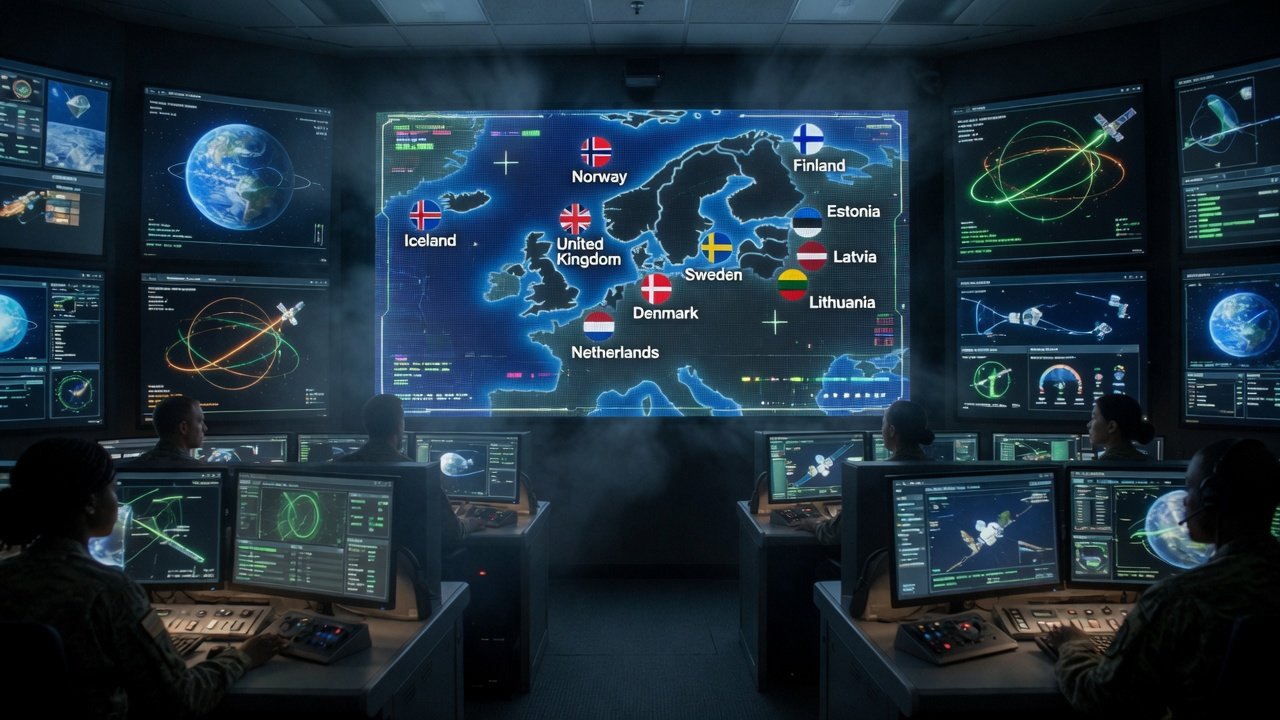
The JEF was set up in 2014 by its original seven founding states and declared operational in 2015. In 2017 Finland and Sweden joined, followed by Iceland in 2021. As of the summer of 2026 the JEF comprises of ten Northern European countries that stretch from the Baltic states, all of Scandinavia, the UK, and all the way to Iceland in the North Atlantic. The member states include Denmark, Estonia, Finland, Iceland, Latvia, Lithuania, the Netherlands, Norway, Sweden, and its leading founding member and home of the JEF’s command, the United Kingdom.
The JEF’s operating area covers some of the most important and strategic geographies in Europe and the North, especially in relation to the JEF’s principal adversary, Russia. The Baltic states and the Baltic Sea, along with Finland and Norway, all face the Russian border. Russia is aggressively asserting its interests in the Arctic and High North, often challenging the legitimate interests of JEF member states. In the North Atlantic, Russian submarines are reconnoitring and even interfering with the undersea cables that are crucial for European and transatlantic data flows, the lifeblood of our economies, and for the ability to command and control military forces across vast geographical distances. Moreover, while the JEF is not a formal NATO organisation, all of its member states to date are NATO members, and the JEF plays a closely supporting role in helping to secure NATO’s Northern and North-Eastern flanks, as well as the crucial lines of communications across the Atlantic Ocean.
The JEF's geographic area just outlined above overlaps with critical European space infrastructure and orbital support networks, placing the space domain firmly within the JEF’s geographical area of responsibility. These space assets are not just a vital support and enabling infrastructure for all JEF operations on the Earth’s surface, but also in cyberspace and EMS, and in the orbits that cross above the operating area. These space systems must, in turn, be defended against an adversary that is actively planning to degrade and even destroy them in war.
In other words, the JEF's traditional geography is becoming an orbital geography.
II. The JEF Is Already a Space Coalition
The JEF already depends upon space systems for virtually every major military function it undertakes in practically every domain it operates in. From sea and air power through to land and cyber and electronic warfare operations, spacepower – defined as the ability in peace, crisis and war to exert prompt influence to, in, and from outer space – plays a vital enabling role. This role is not supplemental or optional, nor is it a capability that is “nice to have” but ultimately expendable in a shooting war. Rather, space is an intrinsic domain that is the fulcrum for activities across the other domains. Whether it is a naval patrol in the Arctic Sea, an amphibious operation in the defence of Norway, or a drone assault against an invading force in the Baltics, spacepower is the silent and invisible enabler of them all.
This spacepower comprises military and commercial satellite communications for strategic, operational, and tactical command and control, especially for beyond line-of-sight operations. Positioning, navigation, and timing (PNT) systems such as the U.S. Global Positioning System (GPS) and Europe’s Galileo for precision navigation and timing services for synchronised operations, simultaneous and mass communications, and drone activities. Intelligence, surveillance, and reconnaissance (ISR) provided by both dedicated military and commercial satellites for optical, synthetic aperture radar (SAR), thermal, and hyperspectral Earth observation, radio frequency (RF) geolocation, and other electronic and signals intelligence collection of the battlespace provide not only strategic early warning, but the required intelligence to tip and cue scarce naval and air assets, whether crewed or uncrewed.
Dedicated military and commercial space systems are also used for maritime domain awareness (MDA) over the Atlantic Ocean, Arctic Sea, and the North and Baltic Seas to track aerial and maritime activities of both friend and foe to ensure safety as well as intercept vessels engaged in everything from illegal fishing and illicit activities — such as vessels involved in Russia’s illicit trade in oil — through to tracking hostile naval activity throughout the operating area. Meteorological and other environmental remote sensing space systems provide vital weather forecasting, oceanographic, and other environmental data in support of operations, intelligence, and resilience. Lastly, ballistic missile early warning satellites, using sensitive infrared sensors, detect and track hostile ballistic missile launches and will be a critical part of any future regional or NATO missile defence system.
Many JEF member states own and operate some of these types of satellite systems, both as dedicated military space assets as well as commercially. Finland, Sweden, and Norway all operate several constellations of ISR satellites — a mix of military and commercial systems, for strategic early warning, targeting and battle damage assessments, and for wide area surveillance of the maritime and Arctic domains. The UK and the Netherlands also operate a mix of military and commercial satellites for ISR and satellite communications. Other space systems and capabilities are planned for the coming years by individual JEF member states that can be used for future JEF operations and security.
Again, this space support is not a supplementary capability: it is an enabling condition for modern coalition warfare. Removal, or denial, of any part - or all - of this space support would cause much of the JEF's military effectiveness to degrade rapidly. This could only be compensated by a greater requirement for mass, which in turn would mean greater casualties. What is noteworthy, however, is that as a military coalition the JEF is, by default, a major space player on the European and wider international stage.
III. The JEF's Hidden Space Geography
The JEF possesses a unique concentration of space infrastructure unmatched elsewhere in Europe, if not the world. The JEF’s area of operations includes key emerging launch infrastructure that will be Europe’s gateway to low-Earth orbit (LEO) for satellite communications, MDA, and ISR satellites. It includes launch sites such as SaxaVord on the Shetland Islands off Scotland, Andøya on the coast of Norway, and Esrange in northern Sweden.
For European and global space-based ISR the JEF area of operations includes ground infrastructure in Svalbard and Tromsø in Norway and Kiruna in Sweden. Military and commercial ISR satellites in Polar and sun-synchronous orbits rely on these facilities to download the imagery they have collected with every pass over the North Pole. That imagery, in the digital form of ones and zeros, is collected by this geographically tight cluster of ground stations, repackaged and relayed through a relative handful of overland and undersea fibre optic cables to data centres of cloud providers in Europe where the data is ingested, put together into a discernible image, and distributed to end-users for analysis and exploitation.
These large volumes of global Earth observation data transit through JEF territory every second of every day and are vital not just for JEF and NATO member states, but for the economic well-being and national security of states in the Middle East, Africa, and much of Asia.
Space Industry Ecosystems
The JEF operating area and member states are also home to a growing and globally significant cluster of space industry ecosystems that feed directly into the region’s economic power as well as its security.
Perhaps most notably, JEF member state Finland is the home of ICEYE, one of the world’s leading and biggest synthetic aperture radar (SAR) satellite companies, as well as to hyperspectral satellite operator Kuva Space and miniature geostationary communication satellite manufacturer ReOrbit. Estonia, Latvia, and Lithuania possess rapidly growing space startup ecosystems, with Lithuania’s small satellite manufacturer Kongsberg NanoAvionics being the most prominent. Norway’s Kongsberg, as well as companies such as Space Norway, are also growing and are manufacturers and operators of both launch infrastructure and satellite constellations that are critical to JEF operations and regional security.
Similarly, Denmark’s GomSpace, Sweden’s SSC, and the Nerherlands’ ISISpace are all leading satellite manufacturers and operators in their fields. GomSpace, for example, is building out an MDA constellation that will provide a more granular operating picture of maritime activities in the JEF operating area. Lastly, the United Kingdom possesses a vibrant space industry that includes Surrey Satellite Technologies Ltd. (SSTL), a renowned small satellite manufacturer, SatVu, a thermal imaging satellite operator, and Inmarsat (now part of ViaSat), a global satellite communications provider.
The JEF operating area is not only emerging as a major node within Europe's space economy, it is the location of space infrastructure that is vital to its own and to global satellite activities.
IV. Space Vulnerabilities and the New JEF Frontier
The same space infrastructure and industrial ecosystems that provide the JEF operational and strategic advantage also create dependencies and vulnerabilities in a rapidly evolving and expanding threat environment.
Russia, China, and other rival and adversarial states and actors are developing various types of counterspace capabilities and operational concepts that can disrupt, degrade, and even outright deny JEF access to crucial space capabilities and support infrastructure.
This is not a theoretical threat. Within the JEF’s own strategic backyard, Russia, and to a lesser extent China, are already actively demonstrating their counterspace capabilities and operational concepts — all of which occur within the JEF’s geographical remit and also threaten to deny it access to space for its operations.
Jamming, Cyber, and Electronic Interference
The most common occurrence of this is through the persistent jamming and spoofing of PNT signals from the GPS and Galileo systems. This jamming and spoofing is particularly common along Europe’s frontier with Russia, such as in the Baltic states, Finland, Norway, and across the Baltic Sea. This jamming interferes with air, sea, and land operations, affecting not only JEF military operations, but also impacting civil aviation and infrastructure, such as railways and other transportation systems in those areas. More recently, U.S. scientists uncovered sporadic but sustained jamming of GPS signals across a vast swathe stretching from Eastern Europe through to the Eastern seaboard of Canada, caused by Russian ballistic missile early warning satellites in highly elliptical ‘Molniya’ orbits over the North Atlantic. It is not clear from current open reporting whether this jamming is intentional or a system malfunction, but the strategic effect is the same – jamming so persistent that the GPS constellation may be unreliable for the most sensitive missions requiring precision PNT support.
Ground Segment Vulnerabilities
The numerous, yet geographically clustered, ground infrastructure on the island of Svalbard and in Tromsø, Norway, and in Kiruna, Sweden, are vulnerable to threats ranging from cyber attacks and jamming of ISR satellite downlinks through to physical sabotage and air and missile strikes in the event of a hot war, and could be degraded and even destroyed in short order. In the past few months, for example, arrests have taken place in Norway of individuals suspected of espionage on behalf of China against space infrastructure at the Andøya spaceport and at facilities owned and operated by SvalSat on the Svalbard archipelago. Any sustained degradation and interference — let alone destruction — of this ground infrastructure will result in space-based ISR feeds brought to a crawl, or even outright denied to JEF and NATO forces.
Subsea Cable Disruption
This tight geographical cluster of ground infrastructure is connected to Europe’s data centres and cloud infrastructure by a small handful of overland and undersea fibre optic cables, all of which are well-mapped and known to adversaries. These cables are relatively easy targets for sabotage, and in some cases tapping, on land and at coastal landing points. The undersea portion of the fibre optic cable network is also vulnerable to interference and tapping by specially designed submarines and other submersible vehicles, something that Russia is routinely doing in the High North and North Atlantic. Again, sustained and concerted efforts by adversaries against cable networks that JEF forces and NATO allies depend upon for delivering the strategic effects of space-enabled ISR will have an outsized impact on operational effectiveness.
Cloud Infrastructure Dependencies
Another vulnerability for JEF’s space-based ISR is the reliance on a handful of data centres and cloud infrastructure at fixed, geographical locations across Europe, particularly in the United Kingdom and Germany, but also in France, Ireland, the Netherlands, and, because of their unique environmental conditions and renewable energy sources, Nordic countries. This data centre and cloud infrastructure is a vital part of getting finished ISR intelligence to JEF operational and tactical end-users and is vulnerable to cyber-attacks, physical sabotage, and air and missile strikes, again leading to lagging or denied space-based ISR feeds.
Commercial Space Dependencies
Much of the space support provided to JEF member states is provided by commercial satellite operators from within JEF countries such as Finland’s ICEYE SAR satellites or the UK’s SatVu thermal imaging satellites, or from other allied countries, such as SpaceX Starlink LEO satellite communications and Planet’s optical Earth observation satellites from the United States. These companies provide vital data and communications and do it exceptionally well, but there are vulnerabilities and strategic dependencies that must be considered in their use. These vulnerabilities include limited physical protection of most commercial satellites against threats such as jamming and spoofing, dazzling of sensors, and so forth.
This lack of protection is often a conscious business choice due to the expensive costs of incorporating them into satellite design and manufacturing, but in a crisis or conflict could make these space systems particularly vulnerable to adversary counterspace activities. Politically, and with recent transatlantic politics in mind, certain dependencies on even allied country commercial space systems could potentially result in limited or denied services in the event of a political divergence of interest over core strategic and national security perceptions and objectives.
Counterspace Competition
Finally, in the orbits around the Earth, China and Russia are demonstrating increasingly sophisticated and potentially lethal counterspace capabilities that include direct-ascent antisatellite (ASAT) systems such as Russia’s Nudol system and co-orbital ASATs that can rendezvous and manoeuvre close to and around friendly space systems and, in the event of war, close in and either interfere or physically destroy their targets. A JEF member state’s satellite has been the target of this kind of co-orbital activity in the past several weeks, when at least four Russian co-orbital ASATs conducted a series of rendezvous and proximity manoeuvres around a Finnish ICEYE SAR satellite. The intentions and rationale for this activity is not publicly known, but it is illustrative of the kinds of counterspace activity that JEF space capabilities may face in the future.
JEF data and imagery flows, along with other satellite services, are strategic arteries upon which all JEF operations depend. The JEF must therefore think aboutspace resilience – on the ground, in cyberspace and the EMS, and in orbit - in much the same way it thinks about terrestrial resilience.
V. Toward a Space-Minded JEF
Given the extensive space infrastructure and space industry ecosystems throughout the JEF operating area, and the JEF’s critical dependencies on space for communications, PNT, ISR, and other support functions, cultivating space-mindedness among its member militaries and command structures is not only advisable it is a strategic requirement.
Space-mindedness can be defined as “building actionable awareness, maintaining situational custody, and integrating space capabilities into broader operations.” Just like its strategic predecessor, sea-mindedness, the aim of space-mindedness would be to build, over time, a strategic culture that instinctively understands the importance of spacepower to the security, prosperity, and power to the JEF and its member states. In immediate and practical terms space-mindedness involves constantly asking the following question: “what is the space dimension of any particular problem?” Moreover, and in the particular case of the JEF, space-mindedness means implicitly and explicitly understanding that spacepower is something that needs to be defended and fought for, not just used.
As JEF planners contemplate and carry out operations, whether humanitarian or military, in the Baltics, in the Arctic and High North, in the North Atlantic, or over the skies of Northern Europe, space support and the space domain should be implicitly and explicitly accounted for as naturally and seamlessly as land, sea, air, and cyber and EMS operations are. Similarly, as JEF planners consider infrastructure protection across the region, space infrastructure should be treated as vital as energy and utilities infrastructure.
In every JEF exercise space denial and PNT degradation scenarios should be actively played out at tactical and operational levels, but also – and crucially – at the political level. Similarly, commercial satellite disruptions, ground segment attacks, and cyber-attacks against space systems must be routinely rehearsed and planned for. Space-mindedness is not just about drawing on space specialists from member state space commands: it is about creating planners and commanders capable of recognising the orbital dimensions of the spectrum of strategic problems the JEF faces.
VI. From Space-Mindedness to a JEF Space Cell
While making the JEF a space-minded force is a necessary step to prepare for future contingencies and threats, there must also be a space entity within the JEF – at both the secretariat and command headquarters levels – to coordinate the space activities and resources of all member states and ensure that they are both defended and used to achieve maximum strategic effect.
To be clear, the JEF does not require a space command, but it does require a permanent Space Cell. This proposed JEF Space Cell would carry out the following functions on behalf of the JEF:
Space Situational Awareness
Using both national and commercial capabilities, the JEF Space Cell should eventually on all coalition space situational awareness (SSA) operations to monitor space traffic, including adversary satellite systems, over the JEF operating area and beyond.
Commercial Space Integration
A JEF Space Cell will also integrate all required commercial space-based ISR and communication needs for the JEF tailored to each particular operation and mission. This function might initially involve coordinating national service-level agreements (SLA’s) with commercial providers to minimise unwanted duplication and disentangle overlapping requirements for space support. Over time, the Space Cell might negotiate its own SLA’s with commercial providers in preparation for various scenarios.
Space Support Planning
The JEF Space Cell would, of course, be responsible for all space support planning, but must be involved at the inception of any wider operational planning to be effective. Moreover, the JEF Space Cell will also be responsible for coordinating the defence of critical space infrastructure on the ground and in orbit.
Vulnerability Assessment
The JEF Space Cell should have an intelligence function to monitor and warn of vulnerabilities and threats against JEF space operations, and those of the space infrastructure and industrial base within the JEF area of operations. These should include supply chain and sabotage vulnerabilities as well as conventional and unconventional military threats against vulnerable JEF space interests.
Intelligence Support
This same intelligence component within the JEF Space Cell should also provide JEF commanders and planners with intelligence on adversary space systems and their supporting infrastructure in the event that the JEF should contemplate offensive space measures. Additionally, as JEF countries adopt their own version of what the U.S. Space Force calls Dynamic Space Operations, the JEF Space Cell will be responsible for coordinating those kinds of operations.#
Education and Training
The JEF Space Cell should also be responsible for leading all JEF-wide education and training efforts across the force. Relatedly, the JEF Space Cell should also be given responsibility for developing JEF-specific space concepts of operations.
Resilience Planning
Lastly, the JEF Space Cell should have a role in advising the JEF secretariat and senior command, as well as individual member states, on making the space enterprise within the JEF more resilient. This resilience should not only be for sound civil reasons, but also to ensure, as much as possible, that in the event of conflict JEF space forces degrade gracefully rather than collapse in short order.
A JEF Space Cell should be relatively small, comprising military and civilian representatives from various JEF member state space commands, making it affordable and practical in its remit. Ultimately, however, the JEF Space Cell should exist to cultivate and institutionalise space-mindedness across the JEF.
VII. Looking Ahead: Canada, Ukraine, Others, and the Expanding Orbital North
Establishing a JEF Space Cell is also timely as other allies consider joining the JEF in the near future. Reports suggest that Canada and Ukraine are both contemplating joining the JEF, with Canada possessing its own military and commercial space capabilities and infrastructure, and Ukraine with its hard-earned expertise in defensive and offensive space domain operations.
Other allies, such as Belgium, France, Germany, and Poland might also choose to join the JEF at some point. Belgium, while modest in size, possesses its own niche space industry, including a specialisation in space-based RF geolocation, while France – the biggest European military space power operating today – brings significant space capability and strategic expertise to the JEF. Germany and Poland, meanwhile, are rapidly growing military and commercial space powers and would bring significant space capabilities to the JEF were they to join.
Even Ireland, a militarily neutral country but one that occupies a key strategic geographical position within the JEF area of operations, might one day choose to join the JEF, given the growing threats to its undersea cable network and its data centre and cloud infrastructure.
Whether or not these countries choose to join the JEF, they all reinforce the growing importance of space infrastructure and North Atlantic space-enabled security that the JEF relies so much upon.
The Orbital Future of the JEF
Since its inception in 2014 much public and military attention has focused – rightly and understandably – on the JEF’s maritime, land, air, and cyber/EMS roles in an increasingly volatile and contested threat environment. Today, the JEF faces not only growing space threats against its space capabilities and space-enabled operations, but it is also home to some of the world’s most critical space infrastructure and some of the most advanced commercial space ecosystems.
The JEF’s security environment increasingly extends to space, and the region it defends is home to prime space real estate. The question, therefore, is not simply whether the JEF should create a Space Cell. The more important question is whether it can develop the strategic culture necessary to recognise and manage the orbital dimensions of Northern European security.
The JEF is already, inadvertently, a space coalition. Its secretariat and command now need to catch up with that reality.